
Rwanda Multi-Country Safaris , When people first look at a map of Africa, East Africa often appears as a collection of separate countries with clear borders and names printed in bold. Rwanda, Uganda, Tanzania, and Kenya look like distinct places, each with its own identity. But once you step onto the land, walk through its forests, cross its plains, and follow its rivers, you begin to understand something important: nature does not recognize borders.
This understanding lies at the heart of Rwanda Multi-Country Safaris – Uganda, Tanzania & Kenya Combinations.
These journeys are not simply about moving from one country to another. They are about following ecosystems, learning how wildlife survives, understanding how cultures adapt to nature, and seeing how conservation works across an entire region. In many ways, a multi-country safari is like reading several chapters of the same book rather than stopping after the first one.
Learning East Africa Through Travel
Travel can be one of the most powerful forms of education. In East Africa, every landscape tells a story, and every animal plays a role in a much larger system.
A traveler who experiences only one destination may see beautiful wildlife. However, someone who experiences Rwanda Multi-Country Safaris – Uganda, Tanzania & Kenya Combinations begins to understand connections:
-
Why gorillas live in misty mountains
-
Why wildebeest migrate across open plains
-
Why rivers shape animal movement
-
Why communities live where they do
This is why educators, photographers, conservationists, and curious travelers increasingly choose multi-country safaris over single-destination trips.
Rwanda: The Classroom Entrance to East Africa
Rwanda is often the first chapter in this learning journey.
Despite its small size, Rwanda has become one of Africa’s most important conservation and tourism models. The country rebuilt itself with a strong focus on education, environmental protection, and responsible development. This approach is visible everywhere—from clean cities to protected national parks.
Most journeys begin in Kigali, a city that introduces travelers to Rwanda’s modern identity before leading them into the natural world. Kigali teaches visitors about resilience, planning, and national unity, preparing them mentally for the deeper lessons that follow in the wilderness.
Rwanda’s strength lies in organization and accessibility, which makes it an ideal starting point for Rwanda Multi-Country Safaris – Uganda, Tanzania & Kenya Combinations.
The Forest Lesson: Rwanda and Uganda Together
The Virunga Mountains as a Living Classroom
The Virunga Mountains stretch across Rwanda and Uganda, forming one of the most biologically important regions in Africa. These mountains are home to mountain gorillas—one of the world’s most endangered species.
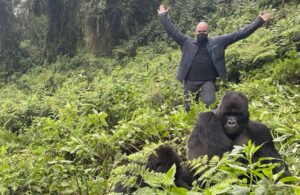
In Rwanda, gorilla trekking takes place in Volcanoes National Park. The experience here is carefully structured. Rangers explain gorilla behavior, family hierarchy, and conservation funding. Visitors learn how tourism supports anti-poaching patrols, veterinary care, and local communities.
Crossing into Uganda, travelers enter Bwindi Impenetrable National Park, where the forest feels older, thicker, and more complex. Paths are narrower, the terrain steeper, and the biodiversity broader.
Together, Rwanda and Uganda teach an important lesson: the same species can survive in different conditions when protected properly.
This dual experience is one of the strongest educational reasons to choose Rwanda Multi-Country Safaris – Uganda, Tanzania & Kenya Combinations.
Understanding Primates Beyond Gorillas
Uganda expands the forest lesson further through chimpanzee trekking in Kibale Forest National Park.
Here, travelers learn how chimpanzees differ from gorillas:
-
Faster movement
-
Louder communication
-
More complex social politics
Observing both species helps visitors understand evolution, intelligence, and adaptation. For students and young learners, this comparison often becomes one of the most memorable lessons of the journey.
The Transition: Leaving the Forest Behind
After days spent under forest canopies, travelers notice a change—not just in scenery, but in mindset. The air becomes drier. The land opens. Sounds carry farther.
This transition is essential. It prepares travelers to understand the next ecosystem: the savannah.
Multi-country safaris allow travelers to feel this transition rather than simply reading about it. This experiential learning is a core strength of Rwanda Multi-Country Safaris – Uganda, Tanzania & Kenya Combinations.
Rwanda and Tanzania: Scale, Movement, and Survival
Before reaching Tanzania’s famous plains, many travelers explore Akagera National Park in eastern Rwanda. Akagera acts as a bridge between forest and savannah, teaching how ecosystems gradually change.
Akagera also tells an important conservation story. Lions and rhinos were reintroduced after disappearing, showing how human decisions can repair damaged ecosystems.
This lesson prepares travelers for Tanzania.
The Serengeti: Nature in Motion
In Serengeti National Park, travelers witness one of the most studied wildlife phenomena on Earth: the Great Migration.
Here, students of nature learn about:
-
Seasonal rainfall patterns
-
Grass regeneration cycles
-
Predator-prey relationships
-
River crossings and survival risk
The Serengeti teaches that wildlife survival is not random—it follows patterns shaped by climate and geography.
When combined with Rwanda’s forest conservation model, Tanzania provides scale and movement, reinforcing why Rwanda Multi-Country Safaris – Uganda, Tanzania & Kenya Combinations offer a complete ecological education.
Kenya: Culture and Wildlife Intertwined
Kenya adds a human dimension to the safari classroom.
In Masai Mara National Reserve, wildlife shares land with the Maasai people, whose culture has coexisted with animals for centuries. Travelers learn that conservation does not always mean removing people—it can also mean working with communities.
This lesson is vital for understanding sustainable tourism and future conservation strategies.
Kenya shows how traditions, livestock, and wildlife can exist side by side when land use is respected and managed carefully.
Borders as Lines, Not Barriers
One of the most powerful lessons taught by Rwanda Multi-Country Safaris – Uganda, Tanzania & Kenya Combinations is that borders are human inventions.
Gorillas move freely across mountain ranges. Birds migrate across continents. Rivers connect countries.
Multi-country safaris encourage travelers to think regionally, not nationally. This mindset is essential for conservation, climate awareness, and responsible travel.
Seasonality as a Teacher
Every season in East Africa teaches something different:
-
Dry seasons reveal survival strategies
-
Wet seasons demonstrate renewal
-
Migration seasons show risk and movement
Because Rwanda offers year-round gorilla trekking, it anchors these lessons and allows flexible planning across seasons, strengthening the appeal of Rwanda Multi-Country Safaris – Uganda, Tanzania & Kenya Combinations.
Why These Safaris Matter for the Future
Beyond tourism, these journeys educate travelers about:
-
Conservation economics
-
Community-based tourism
-
Climate impact on ecosystems
-
Ethical travel choices
For pupils, students, and lifelong learners, a multi-country safari is not entertainment—it is field education.
Final Story: A Journey That Connects Everything
A single-country safari shows you animals.
A multi-country safari shows you systems.
By traveling through Rwanda, Uganda, Tanzania, and Kenya, learners move through forests, plains, cultures, and climates—understanding how each part supports the other.
That is why Rwanda Multi-Country Safaris – Uganda, Tanzania & Kenya Combinations are more than travel experiences.
They are living lessons.
They are stories written by nature.
They are education without walls.