
Rwanda is famous worldwide for mountain gorillas, spectacular wildlife, rolling green hills, and remarkably diverse landscapes. Yet beyond the country’s celebrated national parks lies another experience that gives travelers an intimate look at rural life, agriculture, culture, and some of East Africa’s most beautiful countryside: Rwanda Tea Plantation Tours.
Tea has become an important part of Rwanda’s agricultural landscape, particularly across the cool and fertile highlands of western and southern Rwanda. Vast fields of carefully maintained tea bushes cover hillsides near Nyungwe Forest and other high-altitude areas, creating striking green landscapes that are worth experiencing even before learning how tea travels from a leaf in the field to a cup on the table.
A Rwanda tea plantation experience can include walking through tea fields, meeting local tea workers, learning traditional and modern harvesting techniques, observing tea processing, tasting locally produced tea, photographing the plantations, and discovering the role agriculture plays in rural communities.
For safari travelers, tea experiences are particularly convenient because some of Rwanda’s most attractive plantations are located close to Nyungwe National Park, one of Africa’s most important montane rainforests. A tea tour can therefore be combined with chimpanzee trekking, the Nyungwe Canopy Walk, birdwatching, nature hikes, waterfalls, cultural activities, Lake Kivu, and longer Rwanda safari itineraries.
This complete guide explains the best places for tea tours in Rwanda, what to expect, when to visit, how long a tea experience takes, what to wear, how tea is produced, and how to combine a plantation visit with the country’s major attractions.
What Are Rwanda Tea Plantation Tours?
Rwanda Tea Plantation Tours are guided experiences that introduce visitors to Rwanda’s tea-growing regions and the people, landscapes, and processes behind the country’s tea industry.
Unlike simply stopping beside a plantation for photographs, a properly organized tea experience gives travelers an opportunity to understand how tea is cultivated and produced.
Depending on the plantation and experience selected, your tour may include:
- A guided walk through a tea plantation
- An introduction to Rwanda’s tea-growing history
- Meeting plantation workers and local farmers
- Learning how tea leaves are selected
- Trying traditional tea picking
- Seeing how harvested leaves are collected
- Learning about tea processing
- Visiting a processing facility where access is permitted
- Discovering different grades and varieties of tea
- Tea tasting
- Photography among the tea-covered hills
- Learning about local communities and livelihoods
The exact experience differs according to the estate, season, operational conditions, and arrangements made by your tour operator.
For travelers who want more than wildlife viewing, a tea plantation visit provides an excellent opportunity to understand another side of Rwanda.
Why Is Tea Grown in Rwanda?
Rwanda’s geography provides excellent conditions for growing high-quality tea.
The country is famously known as the Land of a Thousand Hills, and its mountainous terrain creates high-altitude environments with cool temperatures and substantial rainfall.
Tea generally performs particularly well in regions with:
- High elevation
- Regular rainfall
- Moderate temperatures
- Fertile soils
- Good drainage
- Humid growing conditions
Western Rwanda offers many of these characteristics.
Around Nyungwe, the transition between dense rainforest and agricultural land creates especially attractive scenery. The deep green plantations appear to flow across the hills before meeting the darker vegetation of the forest.
The result is not only productive agricultural land but also one of Rwanda’s most photogenic rural landscapes.
Why Take a Rwanda Tea Plantation Tour?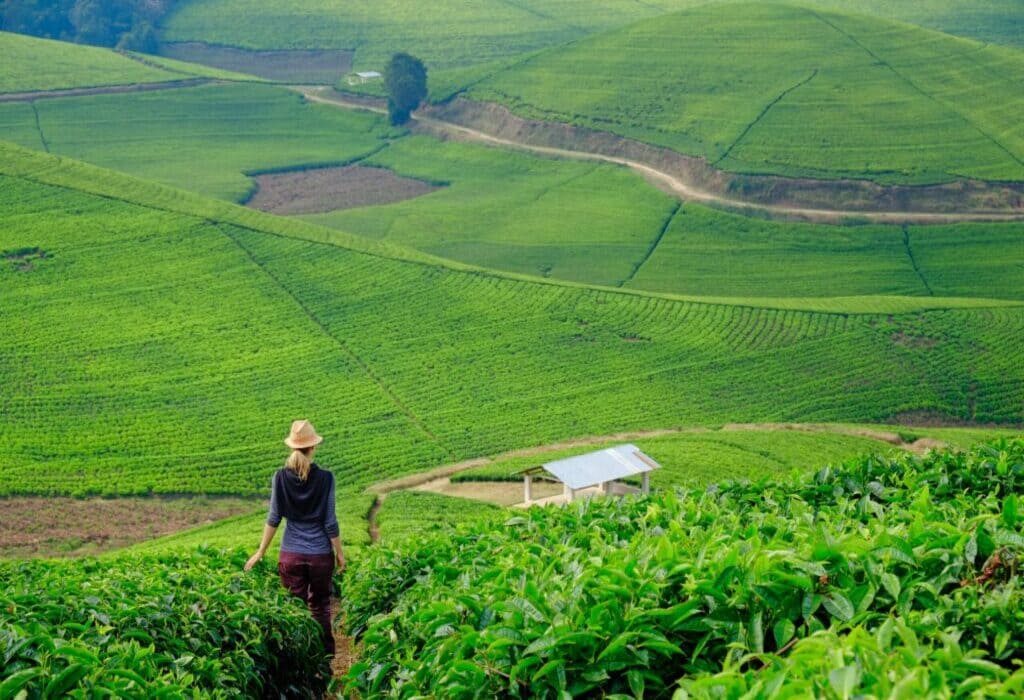
A tea plantation tour can look simple on an itinerary, but it offers several experiences at once.
It combines agriculture, scenery, culture, education, photography, local interaction, and food heritage.
Experience Rural Rwanda
Many international visitors arrive primarily for gorilla trekking or wildlife safaris. These experiences are extraordinary, but they represent only one part of Rwanda.
Traveling through tea-growing areas provides a different perspective.
You encounter working agricultural landscapes and gain greater insight into everyday life outside Kigali and the national parks.
Meet People Behind Rwanda’s Tea
Tea does not begin in a factory.
It begins with people working in the fields.
A well-organized plantation experience can introduce visitors to the skills involved in identifying and collecting suitable tea leaves. Depending on the experience, visitors may have an opportunity to try picking leaves themselves under local guidance.
This makes the tour far more interactive than simply observing the plantation from a vehicle.
Learn How Tea Is Made
Most people regularly drink tea without knowing how much work takes place between harvesting a leaf and preparing a cup.
A tea experience can explain the different stages of production and how processing influences the finished product.
Enjoy Beautiful Landscapes
Rwanda’s tea plantations are extremely photogenic.
Rows of tea bushes curve naturally with the contours of the hills, producing layers of green that can stretch toward forested mountains.
Clouds, mist, workers in the fields, distant forests, and changing sunlight make the region particularly rewarding for landscape photography.
Add Variety to a Rwanda Safari
Tea tours also work exceptionally well as supplementary activities.
After an early chimpanzee trek or between longer driving days, a plantation experience introduces something completely different without requiring another major wildlife expedition.
Best Places for Rwanda Tea Plantation Tours
Tea is grown in several parts of Rwanda, but travelers do not necessarily need to visit every tea-growing region.
For most safari itineraries, the best choice is a plantation that fits naturally into the route.
Gisakura Tea Plantation
The Gisakura tea-growing area is among the best-known tea landscapes for travelers visiting southwestern Rwanda.
Its major advantage is its proximity to Nyungwe.
Visitors traveling for chimpanzee trekking and other Nyungwe activities can often incorporate a tea experience without dramatically changing their itinerary.
The landscape itself is beautiful. Neatly cultivated tea fields contrast with the dense vegetation associated with the surrounding Nyungwe ecosystem.
A guided experience can introduce travelers to tea cultivation, harvesting, rural livelihoods, and the broader journey from plantation to cup.
For photographers, the combination of plantations, mountains, mist, workers, and nearby forest creates excellent opportunities.
Tea Plantations Around Nyungwe
The wider Nyungwe region contains extensive agricultural landscapes, including tea-growing areas around the forest.
For safari planning, these plantations are particularly attractive because they can be combined with:
- Chimpanzee trekking
- Nyungwe Canopy Walk
- Forest hiking
- Birdwatching
- Waterfall hikes
- Colobus monkey experiences
- Community visits
- Lake Kivu extensions
This concentration of experiences makes southwestern Rwanda one of the best destinations for travelers wanting to combine nature, primates, culture, and agriculture.
Tea Estates Along Western Rwanda Routes
Travelers exploring western Rwanda may also see tea plantations while driving through highland areas.
Some are working agricultural estates rather than formal tourist attractions. Therefore, visitors should not assume they can simply enter any plantation.
Organized access is preferable.
A professional guide or Rwanda tour operator can determine which tea experiences are available and arrange visits where necessary.
Rwanda Tea Plantation Tours Near Nyungwe National Park
For most international visitors, Rwanda Tea Plantation Tours near Nyungwe National Park offer the most practical combination of tea tourism and safari experiences.
Nyungwe is one of Rwanda’s major natural attractions and protects an extraordinary high-altitude rainforest ecosystem.
Many visitors come specifically for chimpanzees, but spending additional time around Nyungwe reveals a much broader destination.
The surrounding landscape provides an interesting contrast.
Inside the park, travelers encounter ancient rainforest, towering trees, primates, birds, vines, streams, and thick vegetation. Outside sections of the forest, cultivated hillsides demonstrate how people have shaped neighboring landscapes.
Tea plantations form an important part of this transition.
This means a single stay in the Nyungwe region can provide both wilderness and agricultural experiences.
Combine a Tea Tour with Chimpanzee Trekking
One of the strongest itinerary combinations is chimpanzee trekking and a Rwanda tea plantation tour.
Chimpanzee trekking generally involves an early start. Visitors enter the forest with guides and trackers to search for habituated chimpanzees.
The experience can be physically demanding because chimpanzees move through the forest and conditions vary according to their location.
After trekking, a tea experience provides a slower-paced contrast.
Instead of searching through rainforest, visitors can walk through open plantation landscapes, learn about tea cultivation, and enjoy interaction with local guides or workers.
This makes the combination especially attractive for travelers with limited time in Nyungwe.
A sample day might include:
Early morning: Chimpanzee trekking
Late morning: Return to accommodation and refresh
Lunch: At your lodge or hotel
Afternoon: Guided tea plantation experience
Evening: Relaxation and dinner
The precise timing should always be adjusted according to trekking schedules, driving distances, weather, and the tea experience booked.
Combine a Tea Plantation Tour with the Nyungwe Canopy Walk
The Nyungwe Canopy Walk provides another excellent pairing.
Walking above sections of the forest canopy gives visitors a dramatically different perspective from the open tea fields.
One experience demonstrates Rwanda’s protected rainforest environment; the other highlights its cultivated highlands.
Depending on available schedules, travelers may undertake one activity in the morning and another later in the day.
However, there is no reason to overload the itinerary.
Visitors with sufficient time may enjoy the activities more by spreading them across different days.
What to Expect on a Rwanda Tea Plantation Tour
Travelers often ask what actually happens during a plantation visit.
There is no single standard format, but a comprehensive experience may follow several stages.
1. Welcome and Introduction
Your local guide may begin by explaining the plantation, tea-growing conditions, and importance of tea to the surrounding area.
This introduction provides useful context before entering the fields.
You may learn why particular elevations are suitable for tea, how plantations are maintained, and how harvesting works.
2. Walking Through the Tea Fields
Walking between the rows of tea bushes is one of the most enjoyable parts of the experience.
From ground level, visitors can appreciate how carefully the plantations are organized.
The walk also provides excellent opportunities for photography.
Depending on conditions, some paths may be muddy or uneven, especially during rainy periods.
3. Learning to Pick Tea
Harvesting requires more skill than it initially appears.
Workers know which young leaves should be selected and how to harvest efficiently without damaging the plant.
Where visitor participation is available, a guide may demonstrate the correct method and allow guests to try it themselves.
This is usually one of the most memorable parts of a Rwanda tea plantation experience.
4. Meeting Tea Workers
The human side of tea production is essential.
Tea farming and processing support livelihoods across Rwanda’s producing regions.
Where appropriately arranged, visitors can learn more about plantation work, harvesting routines, and the knowledge required to maintain productive tea fields.
Responsible tourism matters here.
Visitors should treat workers as people rather than photographic subjects. Always ask before taking close-up photographs and follow your guide’s advice.
5. Understanding Tea Processing
After harvesting, leaves need to undergo processing before becoming the tea consumers recognize.
Depending on the specific tea being produced and the facility visited, processing may involve stages such as withering, rolling or maceration, oxidation, drying, sorting, grading, and packaging.
Factory access should never be assumed.
Tea processing facilities are working industrial environments and may have safety, hygiene, production, or visitor restrictions.
If seeing processing is important to you, ask your tour operator in advance whether an appropriate visit can be arranged.
6. Tea Tasting
A fitting conclusion is tasting the finished product.
After spending time among tea bushes and learning about harvesting, drinking locally produced tea takes on a different meaning.
Guides may explain differences in strength, aroma, appearance, processing, or preparation.
It turns an everyday drink into something connected to a landscape and community you have just experienced.
From Leaf to Cup: How Rwanda Tea Is Produced
Understanding the production process adds depth to any plantation tour.
Although exact production methods vary, tea generally passes through several stages.
Tea Cultivation
Tea plants require careful management.
The bushes are maintained so that young shoots can be harvested repeatedly.
Environmental factors such as elevation, rainfall, temperature, soil, and farming practices influence plant growth and ultimately affect the tea produced.
Tea Picking
Harvesting focuses on young growth suitable for processing.
Experienced workers develop speed and precision through practice.
Visitors attempting tea picking often gain immediate respect for the skill involved.
Withering
Freshly harvested leaves contain substantial moisture.
Withering reduces moisture and changes the physical characteristics of the leaf, preparing it for subsequent processing.
Rolling or Maceration
Leaves are then physically manipulated.
The method depends on the production system being used.
This step affects the leaf structure and prepares it for chemical changes that influence the finished tea.
Oxidation
Oxidation is especially important in black tea production.
Controlled exposure influences color, aroma, and flavor.
Timing and production conditions matter because they contribute to the characteristics of the final tea.
Drying
Heat is used to reduce remaining moisture and stabilize the processed tea.
Sorting and Grading
Tea is sorted into different grades according to characteristics such as particle size and production specifications.
Grading should not simply be interpreted as a universal scale from “bad” to “good.” Different grades may be intended for different products, brewing styles, and markets.
Packaging
Once processed and sorted, tea can be prepared for domestic use, sale, or export.
After seeing these stages, visitors usually view a simple cup of tea very differently.
Rwanda Tea Culture and Local Life
Tea tourism becomes much more interesting when it is viewed as more than agriculture.
It is also connected to people, livelihoods, trade, land, and Rwanda’s rural economy.
Traveling through plantation regions exposes visitors to communities that may feel very different from Kigali’s modern urban environment.
You may see farmers working fields, local markets, villages, children walking to school, bicycles carrying goods, and agricultural activity along the roads.
A plantation experience can therefore become part of a wider introduction to rural Rwanda.
The goal should not be to romanticize agricultural labor. Instead, visitors can use the experience to understand the knowledge, work, and economic systems behind products consumed around the world.
Best Time for Rwanda Tea Plantation Tours
One advantage of visiting Rwanda is that travel is possible throughout the year.
Tea-growing landscapes can remain impressively green across seasons, although weather conditions change.
June to September
This period generally overlaps with one of Rwanda’s drier seasons and is particularly popular for safaris and gorilla trekking.
Travel conditions can be favorable, and clearer weather can benefit photography and outdoor activities.
Because this is also a popular period for Rwanda tourism, accommodation and gorilla permits can be in greater demand.
Travelers combining tea experiences with gorilla trekking should therefore plan well ahead.
December to February
Another relatively drier period can also be attractive for visiting plantations and combining them with wildlife and primate activities.
Weather can never be guaranteed, particularly in rainforest environments, so travelers should remain prepared for rain.
Rainier Periods
Rain does not necessarily make a tea plantation visit undesirable.
In fact, clouds and mist can produce beautiful atmospheric landscapes.
The main practical difference is underfoot.
Paths may become wet, slippery, or muddy, so waterproof footwear and rain protection become particularly useful.
How Long Does a Rwanda Tea Plantation Tour Take?
Duration depends on the experience arranged.
A straightforward guided plantation walk may occupy part of a morning or afternoon. More detailed experiences involving demonstrations, processing information, community interaction, or tasting can require longer.
As a general planning principle, allowing approximately two to four hours can work well for many plantation experiences, but travelers should confirm the actual duration of their selected activity.
A half-day experience is often ideal.
It gives enough time to enjoy the plantation without making the day feel rushed.
What to Wear on Rwanda Tea Plantation Tours
Tea fields are agricultural environments rather than paved tourist attractions.
Comfortable clothing is therefore more useful than formal safari wear.
Recommended items include:
- Comfortable walking shoes or hiking shoes
- Lightweight long trousers
- Breathable shirt
- Light rain jacket
- Hat
- Sunscreen
- Insect repellent
- Reusable water bottle
- Small daypack
- Camera or smartphone
- Waterproof protection for electronics
During wet conditions, footwear with reliable grip becomes particularly important.
Temperatures around Rwanda’s higher elevations can also feel cooler than visitors expect, especially early in the morning, during rain, or under heavy cloud.
A light layer is useful.
Photography on Rwanda Tea Plantation Tours
Tea plantations are among Rwanda’s underrated photography locations.
The repetitive rows of tea plants naturally create leading lines and patterns.
Best Photography Opportunities
Look for:
Wide landscapes: Capture the scale of the plantations and surrounding hills.
Workers harvesting tea: When permission is granted, workers among the green fields can provide a powerful sense of place and scale.
Close-up details: Photograph leaves, hands harvesting tea, baskets, water droplets, and plant textures.
Forest and plantation contrasts: Around Nyungwe, agricultural land and rainforest can sometimes be photographed within the same broader landscape.
Mist and clouds: Overcast weather can add atmosphere rather than ruining photographs.
Morning light: Softer light can bring out the shape and texture of the hills.
Visitors should always respect privacy and ask before photographing individuals at close range.
Rwanda Tea Plantation Tours and Sustainable Tourism
Sustainability has become increasingly important to travelers choosing African safari experiences.
Tea tourism can contribute to more diversified tourism when experiences are designed responsibly.
Instead of concentrating visitor spending exclusively around a small number of famous attractions, agricultural and community tourism can potentially broaden the economic footprint of travel.
Responsible visitors should:
- Use authorized guides and experiences
- Respect plantation rules
- Avoid entering private agricultural areas without permission
- Ask before photographing workers
- Avoid interfering with harvesting
- Follow local environmental guidelines
- Purchase local products from legitimate sellers where appropriate
- Avoid littering
- Respect communities encountered along the route
Responsible tourism is ultimately about recognizing that a destination is somebody else’s home and workplace.
Rwanda Tea Plantation Tours and Chimpanzee Safaris
Travelers researching chimpanzee trekking in Rwanda should strongly consider adding a tea experience.
The two activities complement each other exceptionally well.
Chimpanzee trekking provides:
- Wildlife
- Rainforest exploration
- Physical adventure
- Primate behavior
- Conservation education
Tea plantation tours provide:
- Culture
- Agriculture
- Landscapes
- Local livelihoods
- Food and beverage heritage
Together, they produce a more complete understanding of southwestern Rwanda.
A two- or three-night stay around Nyungwe gives visitors much greater flexibility than arriving solely for one chimpanzee trek and immediately leaving.
Rwanda Tea Plantation Tours and Gorilla Trekking
Tea plantations can also be incorporated into longer Rwanda gorilla trekking tours.
The country’s compact size allows visitors to connect several major destinations during a single holiday.
A classic route could include:
Kigali → Nyungwe → Lake Kivu → Volcanoes National Park → Kigali
Along this route, travelers can experience:
- Kigali
- Tea plantations
- Chimpanzee trekking
- Nyungwe rainforest
- Lake Kivu
- Mountain gorilla trekking
- Golden monkeys
- Cultural experiences
This combination is ideal for travelers who do not want their Rwanda holiday to consist exclusively of gorilla trekking.
The gorillas remain a major highlight, but tea, forests, lakes, culture, and landscapes give the journey greater variety.
Rwanda Tea Plantation Tours and Lake Kivu
Lake Kivu is another natural addition to a western Rwanda itinerary.
After exploring Nyungwe and tea plantations, travelers can continue toward communities and resort areas around Lake Kivu.
Depending on the destination and itinerary, activities can include:
- Boat excursions
- Island visits
- Kayaking
- Coffee experiences
- Scenic relaxation
- Fishing-community visits
- Walking
- Cycling
- Congo Nile Trail experiences
Combining tea and coffee experiences can be particularly interesting.
Travelers can compare two of Rwanda’s important agricultural products while learning about their different growing environments, processing methods, and flavor profiles.
Tea Tours vs Coffee Tours in Rwanda
Should you choose a tea plantation tour or a coffee tour?
There is no universal winner.
They offer different experiences.
Choose a Tea Tour If You Enjoy:
- Sweeping green landscapes
- Plantation walks
- Agricultural photography
- Nyungwe itineraries
- Learning about tea production
- Rural highland scenery
Choose a Coffee Tour If You Enjoy:
- Hands-on processing experiences
- Coffee tasting
- Lake Kivu itineraries
- Learning about specialty coffee
- Understanding roasting and preparation
For travelers with enough time, doing both is even better.
A tea experience near Nyungwe followed by a coffee experience around Lake Kivu creates a fascinating agricultural journey through western Rwanda.
Sample 3-Day Nyungwe Tea and Chimpanzee Safari
A short itinerary can combine tea and primates efficiently.
Day 1: Kigali to Nyungwe – Scenic Transfer and Tea Experience
Depart Kigali and travel toward southwestern Rwanda.
The drive introduces visitors to Rwanda’s rolling countryside, towns, farms, and mountainous landscapes.
After arriving in the Nyungwe region, check into your accommodation and enjoy lunch or refreshments depending on arrival time.
In the afternoon, join a guided tea plantation experience.
Walk through the tea fields, learn about cultivation and harvesting, meet local people involved in production where arranged, and discover how Rwanda’s high-altitude environment supports tea farming.
Finish the experience with tea tasting where included.
Return to your lodge for dinner and overnight.
Day 2: Chimpanzee Trekking and Nyungwe Forest Experience
Start early for chimpanzee trekking.
After briefing, enter the forest with experienced guides and trackers.
Listen for chimpanzee calls and follow signs of their movement through the vegetation.
Once the chimpanzees are located, observe their behavior according to the rules governing the trekking experience.
Return for lunch and spend the afternoon relaxing or add another Nyungwe activity according to availability and energy levels.
Overnight near Nyungwe.
Day 3: Canopy Walk and Return to Kigali
After breakfast, explore another section of Nyungwe and undertake the canopy experience if scheduled.
Enjoy elevated forest views before beginning the journey back toward Kigali.
This compact itinerary combines primates, rainforest, agriculture, scenery, and local experiences within three days.
Sample 5-Day Rwanda Tea, Chimpanzee and Lake Kivu Tour
Travelers with more time can explore western Rwanda at a more comfortable pace.
Day 1: Kigali to Nyungwe
Travel from Kigali toward Nyungwe, enjoying Rwanda’s countryside along the route.
Check into your lodge and relax.
Day 2: Chimpanzee Trekking and Tea Plantation Tour
Begin with chimpanzee trekking before returning for lunch.
Spend the afternoon exploring nearby tea-growing landscapes.
Learn about harvesting and tea production and enjoy a tasting where available.
Day 3: Nyungwe Forest Activity
Choose from activities such as the Canopy Walk, forest hiking, birdwatching, or another available nature experience.
Day 4: Nyungwe to Lake Kivu
Leave the rainforest and continue toward Lake Kivu.
Enjoy changing landscapes along western Rwanda before checking into your lakeside accommodation.
Take an afternoon boat trip or simply relax beside the lake.
Day 5: Lake Kivu Experience and Departure
Enjoy a relaxed morning, coffee experience, boat excursion, or other scheduled activity before continuing to Kigali or the next safari destination.
Sample 7-Day Rwanda Tea Plantation and Gorilla Safari
A seven-day itinerary provides enough time to combine Rwanda’s two major primate regions.
Day 1: Arrival in Kigali
Meet your driver-guide at Kigali International Airport and transfer to your hotel.
Relax after your international journey.
Day 2: Kigali to Nyungwe
Travel toward southwestern Rwanda through the country’s scenic highlands.
Arrive near Nyungwe and settle into your lodge.
Day 3: Chimpanzee Trekking and Tea Plantation Experience
Start with an early chimpanzee trek.
After lunch and some rest, explore the surrounding tea plantations with a local guide.
Day 4: Nyungwe to Lake Kivu
Enjoy another scheduled Nyungwe activity before continuing toward Lake Kivu.
Relax beside the lake.
Day 5: Lake Kivu to Volcanoes National Park
Spend part of the morning enjoying Lake Kivu before transferring toward the Volcanoes region.
Check into your lodge near Volcanoes National Park.
Day 6: Gorilla Trekking
After an early breakfast, transfer to the park headquarters for briefing before beginning your mountain gorilla trek.
The duration of the trek varies according to the gorilla family’s location and terrain.
After the experience, return to your lodge and relax.
Day 7: Return to Kigali
Travel back to Kigali for your onward arrangements.
Depending on your flight schedule, additional activities may be possible.
Rwanda Tea Plantation Tours for Families
Tea experiences can work well for families because they are educational and interactive.
Children and teenagers may find it easier to engage with agriculture when they can actually see the plants, walk through fields, and understand where familiar drinks come from.
Parents should nevertheless consider:
- Walking distance
- Weather
- Muddy terrain
- Age suitability of any factory component
- Safety around machinery
- Attention span
- Overall itinerary pace
A shorter plantation experience may work better for younger travelers.
Families combining tea tourism with primate activities should also check age requirements for specific wildlife experiences separately.
Rwanda Tea Plantation Tours for Senior Travelers
Tea plantation experiences can also suit older visitors because they can often be adjusted to a gentler pace.
However, plantations are working landscapes and should not automatically be considered mobility-friendly.
Travelers with limited mobility should ask about:
- Walking distances
- Gradient
- Trail condition
- Availability of vehicle access
- Steps
- Mud
- Resting points
- Toilets
- Accessibility of processing facilities
A private Rwanda safari is particularly useful because the day’s pace can be adjusted around the travelers rather than a larger group’s schedule.
Private Rwanda Tea Plantation Tours
Private tours offer greater flexibility.
They are especially useful for couples, families, photographers, seniors, and travelers combining multiple destinations.
Advantages can include:
- Flexible departure times
- Private transportation
- Personalized pacing
- More photography time
- Easier combination with Nyungwe activities
- Customized accommodation
- Dedicated driver-guide
- Easier itinerary adjustments
A private itinerary can also incorporate tea as one element of a larger Rwanda safari rather than treating it as a standalone excursion.
Rwanda Tea Plantation Tours for Photographers
Photographers should allow more time than ordinary visitors.
A quick plantation stop may produce attractive images, but a dedicated experience gives you time to study light, patterns, human activity, and changing weather.
Consider carrying:
- Wide-angle lens
- Standard zoom
- Portrait lens
- Lens cloth
- Rain cover
- Spare batteries
- Extra memory cards
- Lightweight camera bag
Avoid carrying excessive equipment if significant walking is involved.
Most importantly, respect the people working in the plantation.
Always obtain appropriate permission for portraits.
Rwanda Tea Plantation Tours for Couples
Couples looking for experiences beyond traditional game drives may particularly enjoy tea country.
The landscape is quiet, scenic, and well suited to slow travel.
A couple’s itinerary might combine:
- Tea plantation walk
- Chimpanzee trekking
- Luxury or boutique accommodation
- Forest experiences
- Lake Kivu
- Coffee tasting
- Gorilla trekking
This can create a varied honeymoon or anniversary safari without needing to move between too many countries.
Luxury Rwanda Tea and Safari Experiences
Tea tourism is not limited to budget or midrange travel.
Luxury travelers can incorporate a plantation experience into a high-end Rwanda itinerary using premium lodges, private vehicles, personalized guides, and carefully paced transfers.
The value of luxury in Rwanda is not simply expensive accommodation.
A well-designed luxury journey should provide:
- Excellent logistics
- Privacy
- High-quality guiding
- Comfortable transfers
- Thoughtful pacing
- Carefully selected accommodation
- Seamless activity coordination
- Time to enjoy each destination
A tea plantation experience can add authenticity and contrast to a luxury safari.
After high-end accommodation and exclusive wildlife experiences, spending time learning how a product is cultivated by local communities can give the journey additional depth.
Budget Rwanda Tea Plantation Tours
Tea experiences can also fit naturally into more affordable Rwanda trips.
The key is efficient itinerary design.
Instead of creating a special journey solely for a plantation visit, travelers can add the activity while already staying near Nyungwe.
This reduces unnecessary transportation.
Budget-conscious visitors can save by:
- Choosing comfortable midrange accommodation
- Combining activities geographically
- Avoiding unnecessary backtracking
- Traveling with a small group where appropriate
- Planning ahead
- Selecting experiences based on genuine interest rather than trying to include everything
Rwanda can be an expensive destination when gorilla permits are included, so thoughtful itinerary planning is particularly important.
How Much Do Rwanda Tea Plantation Tours Cost?
There is no single universal price for every tea experience.
Cost depends on factors such as:
- Plantation or experience selected
- Duration
- Private or group arrangement
- Transportation
- Guide services
- Tea tasting
- Processing or factory components
- Community activities
- Accommodation
- Starting location
- Other safari activities included
A tea plantation visit booked as part of a multi-day safari should therefore be evaluated as part of the overall itinerary rather than simply comparing one activity fee.
When requesting a quotation, ask what is actually included.
A slightly higher price may represent private transport, a professional guide, accommodation, meals, and additional activities rather than only plantation admission.
How to Book Rwanda Tea Plantation Tours
The easiest approach is usually to include the experience within a customized Rwanda itinerary.
When contacting a Rwanda tour operator, provide:
- Your travel dates
- Number of travelers
- Preferred accommodation level
- Number of days available
- Whether you want chimpanzee trekking
- Whether you want gorilla trekking
- Whether Lake Kivu interests you
- Your preferred activity level
- Any mobility considerations
- Whether you want a private or shared experience
With this information, the itinerary can be built around geography rather than simply adding attractions randomly.
That makes a significant difference.
A poorly planned itinerary can involve excessive driving and rushed activities. A well-designed itinerary creates a logical journey through the country.
Rwanda Tea Plantation Tour Packing List
For a dedicated tea and Nyungwe itinerary, consider packing:
- Passport and travel documents
- Comfortable walking shoes
- Long trousers
- Long-sleeved shirt
- Lightweight rain jacket
- Warm layer
- Hat
- Sunscreen
- Insect repellent
- Reusable water bottle
- Small backpack
- Camera
- Waterproof camera protection
- Binoculars
- Personal medication
- Power bank
- Universal travel adapter
- Sunglasses
If chimpanzee trekking or forest hiking is included, your packing requirements may be more extensive.
Rain protection is particularly important around rainforest environments.
Health and Safety During Tea Plantation Visits
Tea plantations are generally calm environments, but visitors should remember that they are working agricultural areas.
Follow your guide’s instructions.
Potential considerations include:
- Uneven terrain
- Mud
- Slippery paths
- Rain
- Sun exposure
- Insects
- Agricultural equipment
- Factory machinery
- Vehicle movement
Do not touch machinery or enter restricted areas.
Visitors with allergies, mobility limitations, or other requirements should communicate these before the tour so appropriate arrangements can be considered.
Responsible Interaction with Local Communities
Cultural sensitivity improves the experience for everyone.
When visiting rural areas:
Ask permission before photographing people.
Do not distribute money or gifts indiscriminately.
Follow your guide’s advice regarding community interaction.
Avoid treating people’s homes or workplaces as attractions.
Support legitimate local businesses when purchasing products.
Learn a few simple greetings if possible.
Listen more than you speak when people are explaining their lives and work.
Small acts of respect can make tourism interactions much more meaningful.
Is a Rwanda Tea Plantation Tour Worth It?
For many travelers, yes.
But it depends on what you want from your trip.
If your only priority is seeing mountain gorillas and you have extremely limited time, a plantation tour may not be essential.
If you want a broader understanding of Rwanda, however, it is an excellent addition.
Tea tours are particularly worthwhile for travelers interested in:
- Agriculture
- Food and drink
- Photography
- Rural life
- Culture
- Sustainable tourism
- Landscapes
- Local economies
- Slow travel
- Nyungwe National Park
The activity is also valuable because it contrasts strongly with traditional safari experiences.
Rwanda Tea Plantation Tours vs Traditional Wildlife Safaris
A plantation visit is not intended to replace a wildlife safari.
The two experiences serve different purposes.
A game drive in Akagera might bring you face-to-face with elephants, giraffes, buffaloes, antelopes, hippos, or other wildlife.
A gorilla trek takes you into mountain forests searching for one of the world’s most celebrated primates.
A chimpanzee trek introduces you to another complex primate species within a rainforest ecosystem.
A tea plantation tour focuses on people, agriculture, landscapes, and production.
The strongest Rwanda itineraries often combine several of these themes.
That is what makes the country such an interesting destination.
Combining Tea Plantations with Akagera National Park
Travelers with approximately one week or more can combine tea country with Rwanda’s principal savannah safari destination.
Akagera National Park lies in eastern Rwanda, while Nyungwe is in the southwest, so careful routing is important.
A longer itinerary could follow:
Kigali → Akagera National Park → Kigali/central Rwanda → Nyungwe → Lake Kivu → Volcanoes National Park → Kigali
This route can include:
- Big Five safari experiences
- Boat safari
- Tea plantations
- Chimpanzee trekking
- Rainforest
- Lake Kivu
- Gorilla trekking
- Golden monkeys
- Cultural activities
Travelers should avoid trying to squeeze this entire route into too few days.
Rwanda may be geographically compact, but repeatedly changing accommodation and undertaking activities early every morning can still become exhausting.
Combining Rwanda Tea and Cultural Tours
Tea plantations can also form part of a cultural itinerary.
Instead of focusing only on tea production, a broader experience may explore:
- Farming
- Food
- Crafts
- Traditional knowledge
- Community projects
- Local markets
- Rural landscapes
- Historical sites
The most rewarding cultural experiences tend to be those with genuine context rather than staged interactions created solely for photographs.
Ask your tour operator what the activity actually involves before booking.
Tea Plantation Tours and Rwanda’s Scenic Road Trips
One of the pleasures of traveling around Rwanda is the scenery between destinations.
The journey itself can be part of the experience.
Roads pass through hills, valleys, agricultural areas, towns, villages, forests, and lake landscapes.
Tea-growing regions add another distinctive visual element.
Rather than rushing from attraction to attraction, consider allowing occasional stops for:
- Landscape photography
- Viewpoints
- Local refreshments
- Short walks
- Agricultural experiences
A good driver-guide can help turn transfers into meaningful travel days rather than dead time between hotels.
Rwanda Tea Plantation Tours FAQ
Where Can I Visit a Tea Plantation in Rwanda?
Southwestern Rwanda, particularly the broader Nyungwe and Gisakura area, is one of the most convenient regions for international travelers interested in tea experiences.
It allows plantation visits to be combined naturally with chimpanzee trekking and other Nyungwe activities.
Are Rwanda Tea Plantation Tours Available Year-Round?
Tea-growing regions can be visited throughout much of the year, but exact experiences and access can depend on local operations, weather, plantation schedules, and arrangements.
Always confirm your intended visit before traveling.
Can I Pick Tea Myself?
Some organized experiences may allow visitors to learn about and try tea picking under guidance.
This should only be done where participation is permitted.
Can I Visit a Tea Factory in Rwanda?
Factory or processing visits may be possible in certain circumstances, but access is not automatic.
Factories are operational workplaces and can have safety, hygiene, or visitor restrictions.
Arrange this in advance if it is important to your trip.
How Long Is a Tea Plantation Tour?
Many experiences can fit into a half day.
Actual duration depends on whether your visit includes only the plantation, or also harvesting demonstrations, processing, tasting, and community interaction.
Can I Combine a Tea Tour with Chimpanzee Trekking?
Yes.
This is one of the best combinations in southwestern Rwanda.
Chimpanzee trekking can occupy the morning, while a plantation experience may be scheduled later, subject to activity timings and local conditions.
Is a Rwanda Tea Plantation Tour Suitable for Children?
It can be.
Plantation walks are educational and may be enjoyable for families, but parents should confirm walking conditions, duration, and any age or safety restrictions associated with processing facilities.
What Shoes Should I Wear?
Comfortable walking or hiking shoes with good grip are recommended.
Conditions can become muddy after rain.
Do I Need a Guide?
A guided experience is strongly recommended.
Guides provide context, arrange appropriate access, explain tea production, and help visitors interact respectfully with working agricultural environments.
Can Tea Tours Be Added to a Gorilla Safari?
Absolutely.
A longer Rwanda itinerary can connect Nyungwe, Lake Kivu, Volcanoes National Park, and Kigali.
Are Tea Plantations Good for Photography?
Yes.
The geometric rows of tea plants, rolling hills, workers, mountains, clouds, and nearby rainforest make southwestern Rwanda particularly photogenic.
Is Tea Tasting Included?
This depends on the experience booked.
Confirm inclusions when arranging the tour.
Is Rwanda Tea Different from Coffee?
Yes.
Tea and coffee are completely different plants with different cultivation and processing methods.
Experiencing both tours can provide an interesting introduction to Rwanda’s agricultural economy.
How Far Are Tea Plantations from Kigali?
Travel time depends on the specific plantation, road conditions, stops, and route.
Plantation experiences around Nyungwe should normally be planned as part of a southwestern Rwanda trip rather than treated as a quick Kigali excursion.
Can I Book a Private Tea Plantation Tour?
Private experiences can be incorporated into customized Rwanda safaris, particularly when transportation and guiding are arranged privately.
Planning the Perfect Rwanda Tea Plantation Safari
A successful Rwanda itinerary begins with priorities.
Before booking, decide what matters most.
For example, a first-time visitor might rank activities as follows:
- Gorilla trekking
- Chimpanzee trekking
- Tea plantation experience
- Lake Kivu
- Akagera wildlife safari
- Kigali
- Cultural activities
Another traveler might prioritize photography, agriculture, and culture over wildlife.
There is no single perfect Rwanda itinerary.
The best trip is the one designed around your interests, available time, budget, physical ability, and preferred travel pace.
How Many Days Do You Need?
If tea is your primary interest, a short visit to southwestern Rwanda may be enough.
If you want a comprehensive Rwanda safari, consider spending approximately one week or longer.
3 Days
Suitable for a focused Nyungwe experience incorporating chimpanzees, tea, and another forest activity.
5 Days
Allows Nyungwe to be combined with Lake Kivu or another nearby destination at a more comfortable pace.
7 Days
Provides enough time to connect Nyungwe, tea plantations, Lake Kivu, and Volcanoes National Park.
10 Days or More
Better suited to travelers wanting a comprehensive itinerary including Akagera, Nyungwe, Lake Kivu, Volcanoes National Park, Kigali, wildlife, primates, agriculture, and cultural experiences.
More time usually improves the trip because it reduces the pressure to rush between destinations.
Why Add Rwanda Tea Plantation Tours to Your African Safari?
East Africa is renowned for wildlife.
Travelers cross the region searching for gorillas, chimpanzees, lions, elephants, rhinos, wildebeest, leopards, and countless other species.
These experiences deserve their reputation.
But Africa is not simply a collection of national parks.
Its landscapes are also shaped by agriculture, communities, cities, history, trade, food, and everyday life.
Rwanda Tea Plantation Tours introduce travelers to this broader perspective.
They encourage visitors to slow down and look closely at a product many people consume without considering its origin.
You walk through the fields.
You see how tea grows.
You discover what workers look for when harvesting leaves.
You learn how processing transforms fresh leaves.
And finally, you may taste tea produced from the same landscape you have just explored.
That progression—from plant to person to process to cup—is what makes the experience memorable.
Tips for Choosing the Best Rwanda Tea Plantation Tour
Not every plantation visit offers the same quality of experience.
Before booking, ask what is included.
A good tour should ideally provide meaningful interpretation rather than simply transporting visitors to a field.
Consider asking:
- Is the experience guided?
- How long does it last?
- Can visitors walk through the plantation?
- Is tea picking demonstrated?
- Can guests participate?
- Is processing explained?
- Is a factory visit included or available?
- Is tea tasting included?
- Is transportation included?
- Is the activity private or shared?
- What footwear is recommended?
- How physically demanding is the walk?
- Can it be combined with Nyungwe activities?
These questions make it easier to compare experiences fairly.
Booking Rwanda Tea Plantation Tours as Part of a Customized Safari
For international travelers, tea experiences usually make the most sense within a broader Rwanda itinerary.
A professional local tour operator can coordinate transportation, guides, accommodation, activity schedules, and connections between destinations.
This is particularly important when combining the plantation with activities that operate according to fixed schedules or require advance permits.
A customized itinerary can include:
Kigali for arrival, departure, and city experiences.
Akagera National Park for savannah wildlife and game drives.
Nyungwe National Park for chimpanzees, rainforest, canopy experiences, and tea plantations.
Lake Kivu for relaxation, boats, coffee, and scenic activities.
Volcanoes National Park for mountain gorillas and golden monkeys.
Instead of booking each element independently, integrating the trip can reduce unnecessary transfers and improve the overall pace.
Rwanda Tea Plantation Tours: A Different Way to Discover the Land of a Thousand Hills
Rwanda’s mountain gorillas may bring travelers to the country, but its diversity often leaves the deeper impression.
Within a relatively compact destination, visitors can experience savannah, rainforest, volcanic mountains, lakes, modern cities, agricultural highlands, and rural communities.
Tea country belongs in that story.
The plantations reveal how Rwanda’s climate, elevation, soils, people, and landscapes come together to create an internationally traded agricultural product.
They also offer something increasingly valuable in modern travel: the chance to slow down.
Instead of racing toward another wildlife sighting, visitors can walk.
They can listen.
They can learn.
They can observe how leaves are harvested and understand how much human effort sits behind an ordinary cup of tea.
And they can enjoy some of the most beautiful green landscapes in Rwanda.
For travelers visiting Nyungwe, adding a tea experience is particularly easy to justify. It complements chimpanzee trekking and forest exploration without duplicating them.
For travelers undertaking a longer Rwanda safari, it creates a natural bridge between wildlife, culture, agriculture, and scenery.
Whether you are a photographer, couple, family, solo traveler, luxury safari guest, agricultural enthusiast, or first-time visitor to East Africa, Rwanda Tea Plantation Tours can add a rewarding dimension to your journey.
A well-planned trip might begin among Kigali’s hills, continue through tea country and the ancient forests of Nyungwe, follow the shores of Lake Kivu, and eventually reach the volcanic landscapes where mountain gorillas live.
By the end, you will have experienced far more than a single attraction.
You will have discovered several different faces of Rwanda.
And somewhere along that journey, standing between endless rows of brilliant green tea bushes with the highlands stretching into the distance, you may discover that one of the simplest activities on your itinerary becomes one of the most memorable.
Plan Your Rwanda Tea Plantation Tour
Ready to explore Rwanda beyond the traditional safari?
Combine Rwanda Tea Plantation Tours with chimpanzee trekking in Nyungwe National Park, the Nyungwe Canopy Walk, Lake Kivu, coffee experiences, mountain gorilla trekking in Volcanoes National Park, or a Big Five safari in Akagera National Park.
Whether you have three days or two weeks, a carefully designed private itinerary can connect Rwanda’s wildlife, forests, plantations, lakes, culture, and communities into one seamless journey.
Book Rwanda Tea Plantation Tours with Universal Ventures Rwanda
Planning to explore Rwanda’s tea plantations, Nyungwe National Park, Lake Kivu, Volcanoes National Park, or Akagera National Park? Universal Ventures Rwanda can arrange customized private safaris, tea plantation experiences, chimpanzee trekking, gorilla trekking, cultural tours, and multi-day Rwanda itineraries.
For bookings, quotations, and personalized Rwanda safari planning, contact:
Universal Ventures Rwanda
Email: info@universalventuresrwanda.com
Phone / WhatsApp: +250 781 441 853
Address: Kigali, Rwanda
Our team can help you combine Rwanda Tea Plantation Tours with chimpanzee trekking in Nyungwe, Lake Kivu experiences, gorilla trekking in Volcanoes National Park, and wildlife safaris in Akagera National Park.